How to Stay Warm in a Cold Basement (Safely)
Warm yourself and the floor before you try to heat the room: a thick rug over the concrete, sealed gaps where the foundation meets the house frame, a dehumidifier if it is damp, and a long layer while you sit. Never use an unvented fuel heater, a grill or a generator in a basement, and keep a carbon monoxide alarm on that level.

이 가이드의 내용8
Last updated: 16 November 2026.
To stay warm in a cold basement, deal with safety first, then the floor, then the drafts, and warm yourself before you try to warm the room. A thick rug over the concrete, sealed gaps at the top of the foundation walls and a dehumidifier do more than most heaters. For long spells sitting still down there, a long layer such as Enfold, the hooded cape we make, keeps your own heat around you with no fuel and no cord. Never heat a basement with an unvented fuel heater, a grill or a generator.
Safety first: carbon monoxide and heaters
The basement often holds the furnace and water heater, and it is where people reach for a portable heater. Checked 16 November 2026:
- The EPA lists "unvented kerosene and gas space heaters" among indoor sources of carbon monoxide, and advises: "Consider purchasing a vented space heater when replacing an unvented one" (EPA).
- The CDC: "Never heat your house with a gas oven." "Do not use portable flameless chemical heaters indoors." Have your heating system, water heater and any other gas, oil or coal burning appliances "serviced by a qualified technician every year" (CDC).
- The Consumer Product Safety Commission: "Never use a generator inside a home, basement, shed or garage." CO alarms "should be placed on every level of the home and outside sleeping areas," and you should "Test the alarms every month" (CPSC, January 2026).
For an electric space heater, the CPSC's rules are to keep it "at least three feet away from drapes, furniture, bedding and other combustible materials," to plug it "directly into a wall outlet—never into an extension cord or power strip," and to "Turn off heaters when sleeping." Carbon monoxide has no color and no smell; the CDC lists headache, dizziness, weakness, upset stomach, vomiting, chest pain and confusion as the most common symptoms. If anyone has them, get into fresh air and call 911.
Ways to warm a basement, compared
| Option | What it fixes | Cost | Watch out for |
|---|---|---|---|
| Rug with a thick pad over the concrete | Cold floor | Low | Lay it on a dry floor only |
| Seal gaps at the sill plate and around pipes | Drafts at the top of the walls | Low | Leave the furnace and water heater's air supply clear |
| Dehumidifier | Damp, clammy air | Medium | Empty or drain it; aim for the EPA range below |
| Long hooded layer while you sit (Enfold) | Cold while still at a desk or on a sofa | Higher | Makes no heat of its own; not for stairs in a hurry |
| Electric space heater | A small area for a while | Medium, plus power | The CPSC rules above; off when you leave or sleep |
| Unvented kerosene, propane or gas heater | Not recommended indoors | n/a | Listed by the EPA as a carbon monoxide source |

Why a basement feels colder than the thermostat says
Concrete floors and walls against the ground stay cold and pull heat from you even when the air is mild. Cold air sinks down the stairs and pools. And damp cushions and bedding feel colder than dry ones. Our guide to why you feel cold at home goes further into the cold-surface side.
Deal with damp early. The EPA's guidance: "If possible, keep indoor humidity below 60 percent (ideally between 30 and 50 percent) relative humidity." It also says to "Cover cold surfaces, such as cold water pipes, with insulation" (EPA).
Fix the floor
A rug over the concrete, with a thick pad or interlocking foam tiles underneath, is the biggest single change for the money. A sofa or chair on legs keeps you out of the coldest layer of air. Wear wool socks and slippers with a thick sole. More in how to keep your feet warm at home.
Seal the drafts at the top of the walls
The Department of Energy calls air leaks "among the greatest sources of energy loss in a home" and says "By sealing uncontrolled air leaks, you can save 10%–20% on your heating and cooling bills." Its list of places to seal includes sill plates, plumbing and utility access, ducts, and water and furnace flues (DOE Energy Saver guide). In a basement that means the line where the foundation wall meets the wooden frame of the house, and every pipe and cable that comes through it. Caulk small gaps and use foam on larger ones.
Around the furnace and a gas water heater vent, the DOE says to seal only "with fire-resistant materials such as sheet metal or sheetrock and furnace cement caulk." Never block the air those appliances need to burn safely; if unsure, ask at the yearly service.
Warm yourself while you sit
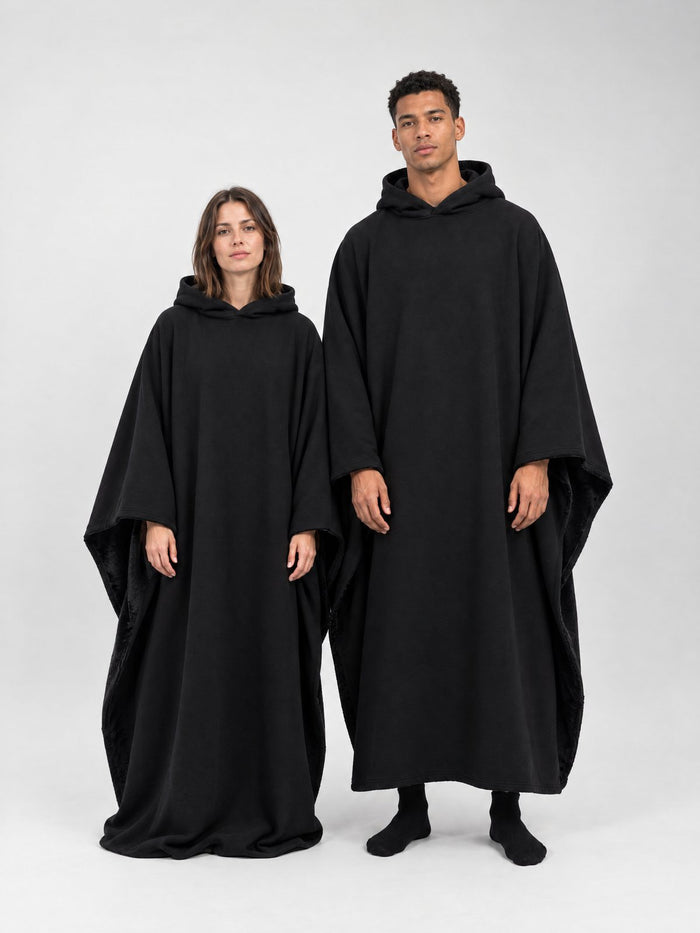
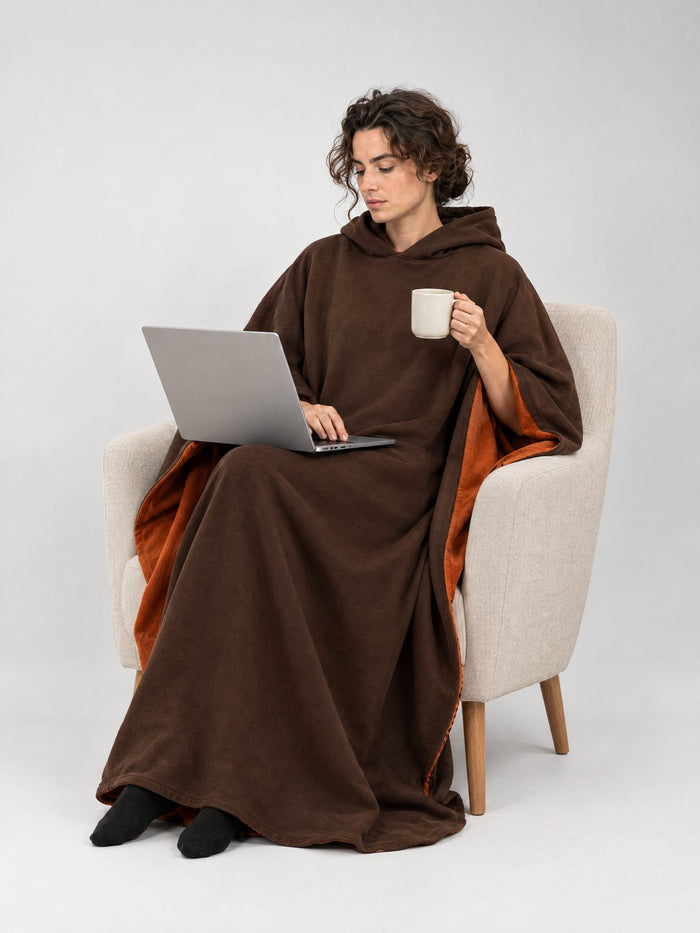
Most basement cold is about sitting still. Layer up, then add one long layer. Enfold runs 56 inches (142 cm) from shoulder to hem, so when you sit, your legs and feet are inside it with the rest of you. It is open down both sides with no sleeves, so your hands come out for a keyboard or a controller, and the deep hood covers the back of your neck. The front is one continuous panel with no zip and no slit, so a draft has no gap to find. For the desk setup, see staying warm working from home.
Two basement rules: gather the hem or take it off before steep basement stairs, and keep it, like any blanket, well away from the furnace, water heater, wood stove and any space heater.
What a long layer will not do
- Heat the room. It keeps your own heat in; it makes none.
- Sleeves and pockets. There are none. Your phone goes on the desk.
- Sizes. One size. On shorter people the hem reaches the floor, which is fine on a sofa and a nuisance on stairs.
- Price. It costs more than a fleece throw. Do the rug and socks first.
- Who it is for. Adults sitting and pottering. Not babies, young children or wheelchair users (the hem sits near the wheels).
If the basement is where you work or wind down and you are still cold after the rug and the sealing, see today's price for Enfold. Delivery is free; import taxes can apply in some countries.
Common questions
How do I stay warm in a cold basement?
Rug and pad over the concrete, sealed gaps where the foundation meets the frame, a dehumidifier for damp, and wool socks and a long layer while you sit. If you add heat, use a vented or electric heater and follow the safety rules.
Is it safe to use a propane or kerosene heater in a basement?
Not an unvented one. The EPA lists unvented kerosene and gas space heaters as indoor carbon monoxide sources and suggests a vented heater instead. Keep a CO alarm on that level either way.
Do I need a carbon monoxide alarm in the basement?
The CPSC says CO alarms should be on every level of the home and outside sleeping areas, tested every month. A basement with a furnace or water heater is a level.
더 읽어보기